
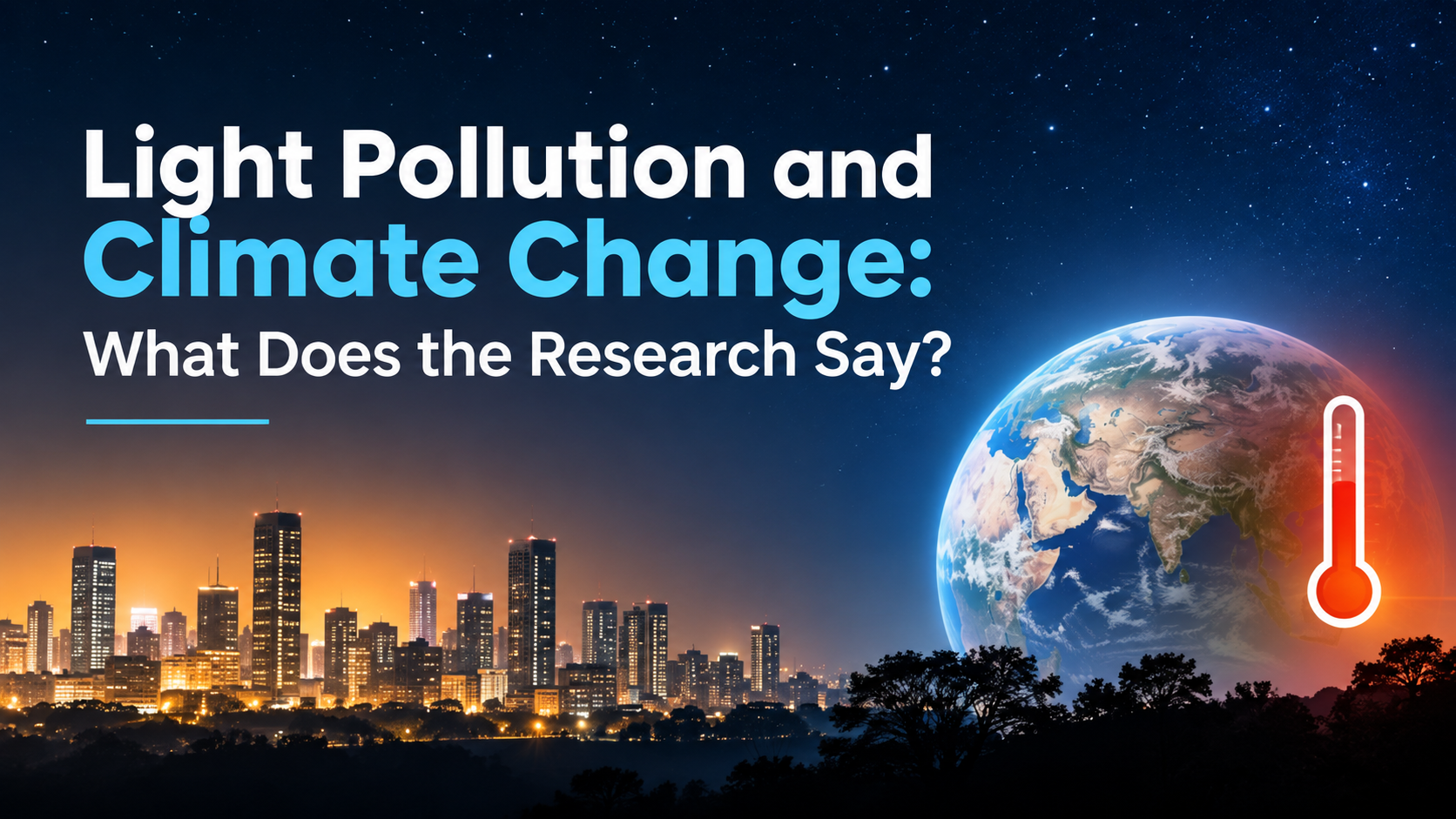
For most people, a bright night sky is a sign of a thriving city. Streetlights, illuminated billboards and glowing office towers feel like progress. Yet scientists are increasingly asking whether that glow comes with a hidden cost. The question of light pollution and climate change was once a fringe topic, but a landmark 2025 study has pushed it into the mainstream of environmental science. In this post, Save Darkness looks at what the research says about artificial lighting, energy use and the way ecosystems process carbon, and where the evidence is still thin.
Artificial Lighting and Energy Use
The most direct link between light pollution and climate change runs through electricity. Lighting accounts for around 15% of global electricity use, according to figures cited by Cranfield University researchers. Where power comes from coal or gas, every unnecessary lumen carries a carbon cost.
That figure is not a perfect measure of waste, because it covers all lighting, including indoor lighting, not only the needless outdoor kind. But it shows why cutting excess illumination matters. Lighting is also a classic example of the rebound effect. LEDs use far less energy per unit of light, but because they are cheap and easy to install, many places have simply added more of it. Efficiency gains are partly cancelled out, which helps explain why the world's lit area keeps expanding even as the technology improves.
Energy is the familiar half of the story. The newer and more surprising half is what happens to living systems under that light.
What Research Says About Ecosystem Carbon Processes
In November 2025, a team led by Dr Alice Johnston of Cranfield University published a study in Nature Climate Change titled "Widespread influence of artificial light at night on ecosystem metabolism." The researchers combined satellite records of night-time light with data from 86 carbon flux monitoring sites across North America and Europe, drawn from the FLUXNET2015 network. These towers track how much carbon dioxide moves between land and atmosphere, in some cases every half hour.
The key finding involves two opposing processes:
-
Respiration: plants, microbes and animals release carbon dioxide as they live and grow. Brighter nights were linked to higher ecosystem respiration.
-
Photosynthesis: the process that pulls carbon dioxide out of the air. The team found no matching increase.
Put together the balance tips. Ecosystems exposed to artificial light stored less carbon than comparable darker ones, which matters because forests and grasslands are major carbon stores. The authors say this has implications for global carbon budgets.
The work is described as the first to show this pattern across entire continents rather than at a single site. The authors also point out that light pollution is rarely included in climate models, which typically track land-use change, agriculture and fossil fuel emissions. They argue it should now be considered alongside those other drivers of carbon cycling.
How Strong Is the Evidence?
It is worth being careful here. The research points to a meaningful signal, but several caveats apply.
First, the study draws on 86 sites in two continents. Those are the most light-polluted regions, but patterns may differ in the tropics, where much of the world's biodiversity and carbon storage sits. Second, flux towers measure whole-ecosystem exchange, so the findings show a strong association rather than a neatly isolated cause. The biological mechanisms, whether they involve microbes, insects, plant behaviour or changes in animal activity, still need to be unpacked. Third, the authors describe the shift in carbon balance as subtle. Light pollution is not a rival to fossil fuel burning, and no serious researcher suggests that dimming streetlights alone will solve global warming.
The fair summary is that the relationship between light pollution and climate change is real enough to deserve a place in climate science, but its global size remains an open question.
Wider Ecological Costs
Even setting carbon aside, artificial night light disrupts nature. It can send migrating birds off course, interfere with feeding and reproduction in nocturnal animals, and shift human sleep patterns and circadian rhythms. Summaries of DarkSky International's annual State of the Science review, which collates recent peer-reviewed work, now describe outdoor lighting as a climate-relevant issue as well as an ecological one. Newer findings even suggest artificial light may interfere with insect hibernation. Each of these effects adds weight to the case for using less light, and using it better.
What Can Be Done?
Unlike many climate stressors, light pollution can be reversed quickly. Johnston has said that, unlike climate change, it could be reduced almost overnight with better lighting design. Practical steps include:
-
Dimmable lighting that adjusts to actual need.
-
Directional, shielded fixtures that point light down at the ground rather than into the sky and surrounding habitat.
-
Spectrally sensitive lighting, such as warmer tones with less blue light.
-
Timers and motion sensors so that non-essential lights are off when nobody needs them.
-
Protected dark areas around wild habitats and green spaces.
The benefits extend beyond carbon, which is why Save Darkness champions smarter, more responsible outdoor lighting. Cities can lower electricity bills, residents can sleep better, and wildlife gets its night back. Johnston has called this a rare win-win-win for the environment, energy efficiency and wellbeing.
Conclusion
So, does light pollution affect climate change? The evidence says yes, through two routes. Wasted lighting burns electricity, and in many regions that means avoidable emissions. Artificial light also appears to nudge ecosystems toward releasing more carbon than they absorb. The size of the global effect is still uncertain, and more studies, especially outside Europe and North America, are needed.
But the cost of acting is low and the co-benefits are high. As research on light pollution and climate change matures, expect lighting design to become a bigger part of climate-friendly urban planning. Turning off what we do not need may be one of the simplest climate steps available. That is the idea behind Save Darkness: protect the night, and the climate and wildlife benefit with it.